


The US-China tech rivalry is the long-running competition between the United States and China for leadership in the technologies that will shape the next few decades: advanced chips, artificial intelligence, telecom networks, and the industries built on top of them. Both countries are pouring enormous resources into research, manufacturing, and talent, and both are using trade rules, investment limits, and industrial policy as tools to protect their position. It is not a single dispute or a single law. It is a broad contest over who sets the standards, controls the supply chains, and builds the defining technologies of the coming era.
This rivalry did not appear overnight. For years, the two countries’ tech industries were deeply intertwined: American companies designed chips and software while Chinese factories assembled the devices, and both sides profited from the arrangement. Over time, though, technology became inseparable from national security and economic power. Governments on both sides started treating key technologies as strategic assets rather than ordinary trade goods, and the relationship shifted from cooperation to competition. That shift is what people mean when they talk about the tech rivalry.
Why should you care? Because this contest quietly shapes the devices you buy, the apps you use, the price of electronics, and the direction of entire industries. When governments restrict the sale of advanced chips or equipment, it ripples through supply chains and eventually reaches store shelves. When two giant economies race to lead in AI, the pace of innovation speeds up for everyone, but so does the uncertainty. Understanding the basics of this rivalry helps you make sense of headlines that otherwise sound like abstract geopolitics.
This guide explains the rivalry in plain terms: how it started, where the main battles are being fought, why chips sit at the center of everything, how the AI race fits in, what it means for consumers and businesses, and what to watch next. No jargon, no hype, just the concepts that actually matter.
How the Rivalry Started
The roots of the rivalry go back to the way the global tech industry grew. For a long stretch, the model worked like this: American firms led in chip design, software, and platforms; factories in China and elsewhere in Asia handled manufacturing and assembly at a scale no one else could match. It was efficient, profitable, and largely peaceful. Consumers got cheaper devices, and companies on both sides grew fast.
Two things changed that. First, China decided it did not want to stay in the assembly role forever. Through long-term industrial plans, heavy state investment, and a huge push into research and education, it began climbing the value chain: building its own chip companies, its own telecom equipment makers, its own electric vehicle brands, and its own AI labs. That ambition was open and deliberate. Second, the United States and its allies began to view that climb as a strategic risk. Technologies like advanced chips and AI are not just commercial products; they also power military systems, surveillance, and critical infrastructure. Once both sides started seeing technology through a security lens, cooperation gave way to controls.
The turning point was not one event but a pattern. Export controls on advanced chipmaking equipment, restrictions on investment flowing between the two countries, blacklists of specific companies, and countermeasures on critical materials all became normal tools. Each move prompted a response, and the responses piled up into the rivalry we see now. Neither side shows any sign of backing down, because both believe technological leadership is tied directly to their future prosperity and security.
Key Battlegrounds
The rivalry plays out across several fronts at once. Here is a map of the main ones and what each side is trying to achieve. The descriptions are deliberately qualitative: the exact policies and figures change constantly, but the underlying goals have stayed consistent.
| Battleground | What it is | US focus | China focus |
|---|---|---|---|
| Semiconductors and chips | the tiny processors and memory chips inside every modern device, from phones to data centers to weapons systems. | keeping a lead in the most advanced chip designs and the complex equipment used to make them, and limiting rivals’ access to both. | building a self-sufficient chip industry, from design to manufacturing, so it no longer depends on foreign suppliers for critical components. |
| Artificial intelligence | the models, data, and computing power behind everything from chatbots to image recognition to autonomous systems. | leading in cutting-edge AI models and the high-end computing hardware that trains them, while setting the safety and governance norms. | matching or surpassing Western AI capabilities, applying AI across industry and government at massive scale, and shaping global AI standards. |
| Telecom and 5G | the networks and equipment that carry the world’s mobile data. | ensuring trusted vendors build the networks its allies rely on, and keeping rivals’ equipment out of sensitive infrastructure. | exporting its telecom equipment and standards worldwide, especially to developing countries, and leading in next-generation network research. |
| EV batteries and clean tech | the batteries, solar components, and supply chains behind electric vehicles and renewable energy. | building domestic and allied supply chains for batteries and clean energy so the energy transition does not depend on one country. | defending its dominant position in battery manufacturing and mineral processing, which it built up over many years. |
| Cloud and quantum | the data centers that power the internet, plus quantum computing, a still-early technology that could one day break current encryption and solve problems today’s computers cannot. | maintaining leadership in cloud infrastructure and quantum research, with heavy private-sector and government investment. | catching up in cloud scale and pushing hard on quantum communication and computing as a long-term bet. |
Why Chips Sit at the Center
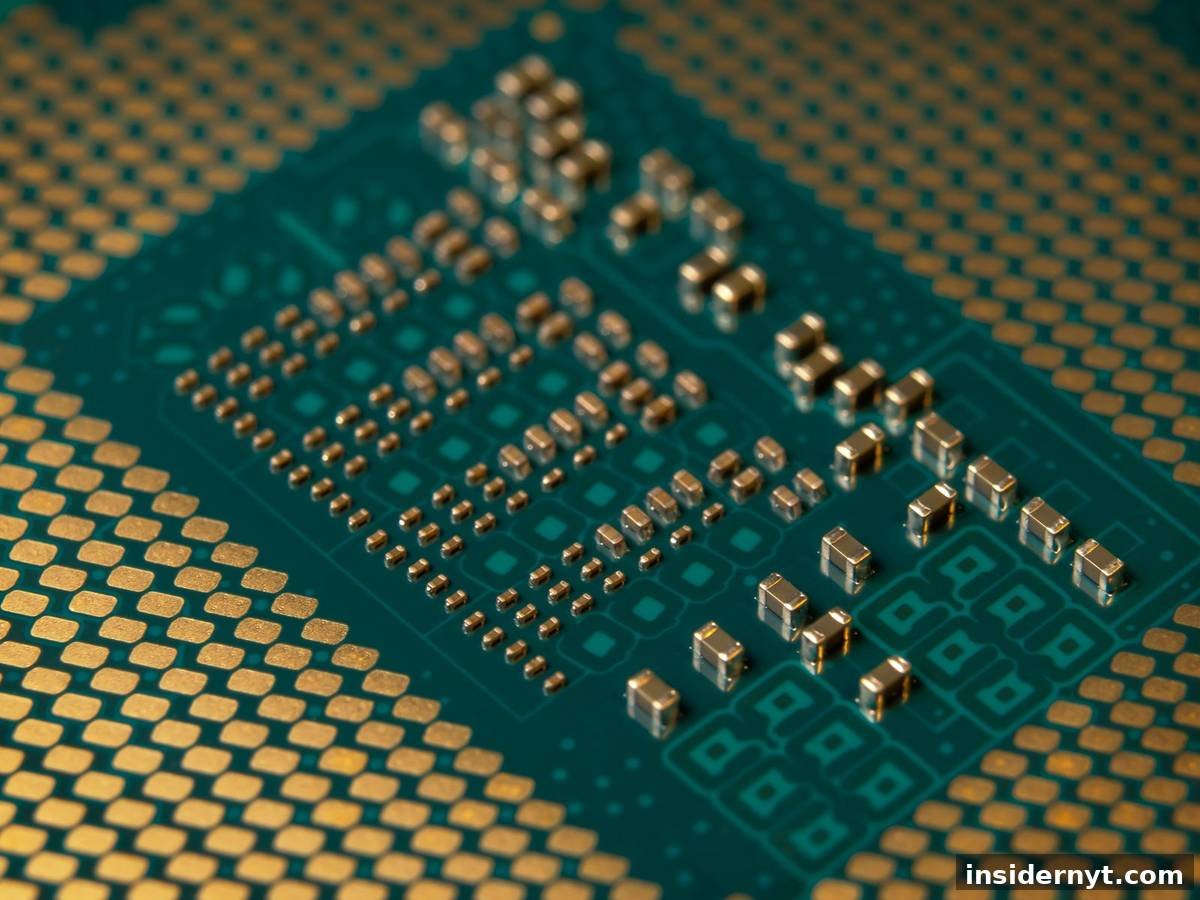
Chips are the center of the rivalry for a simple reason: everything else depends on them. AI models need advanced processors to train. Telecom networks need them to run. Electric vehicles, phones, data centers, and military systems all run on chips. Whoever controls the most advanced chips — and the equipment to make them — holds leverage over every other technology.
Making advanced chips is also one of the hardest things humans do. It requires extreme precision, rare materials, and machines so complex that only a handful of companies in the world can build them. The supply chain spans dozens of countries: design in one place, equipment from another, manufacturing concentrated in a few locations. That concentration is exactly what makes chips a pressure point. A restriction at one chokepoint ripples everywhere.
This is why so much of the rivalry’s policy action centers on semiconductors: who can buy the most advanced ones, who can build the machines that make them, and who is investing to become independent of the others. If you understand the chip story, you understand most of the rivalry.
The AI Race Within the Rivalry
Artificial intelligence deserves its own section because it is both a battleground and an accelerant: the rivalry shapes AI, and AI raises the stakes of the rivalry.
The race has several dimensions. First is computing power: training leading AI models requires enormous numbers of advanced chips, which is why chip access and AI leadership are the same fight. Second is data: both countries have vast digital ecosystems generating training data, though of different kinds. Third is talent: researchers, engineers, and the universities and labs that produce them. Fourth is deployment: getting AI into real products, factories, and government services at scale.
Our AI news coverage follows how quickly this field moves, and the pattern is consistent: breakthroughs on one side prompt accelerated effort on the other. The result is faster progress for everyone — along with sharper competition over the inputs that make progress possible.
One underappreciated angle: AI also changes the rivalry itself. AI-designed chips, AI-optimized supply chains, and AI-assisted research all feed back into the contest. The rivalry is not just about who has the best AI today; it is about who can use AI to pull ahead in everything else tomorrow.
What It Means for Consumers and Businesses
For ordinary consumers, the rivalry mostly shows up as background noise with occasional sharp edges. Most days, you will not notice it. But it affects the price and availability of electronics, the features in your phone, which apps are available in your country, and how fast new technologies reach you. When supply chains shift, product launches slip or prices creep up. When app ecosystems split along geopolitical lines, consumers end up with fewer choices.
For businesses, the effects are more direct. Companies that sell globally now have to navigate two overlapping sets of rules: export controls, investment screening, data localization requirements, and shifting lists of restricted partners. Supply chain planning that once optimized purely for cost now has to weigh political risk. Some firms are building parallel supply chains — one serving each sphere — which is expensive but increasingly seen as necessary.
Small businesses feel it too, mostly through costs. If you run an online store, a homepage like ours covering tech explainers can help you follow the story, but the practical move is simpler: diversify suppliers where you can, avoid depending on a single country for critical inputs, and keep an eye on the policy headlines that affect your sector. The prop tech and b2b tech guides touch on how businesses adapt technology strategy under uncertainty — the same instincts apply here.
The big picture: the rivalry adds friction to a global tech economy that spent decades removing it. That friction is now a permanent planning factor, not a temporary disruption.

What to Watch Next
If you want to follow this story without drowning in daily headlines, watch a handful of slow-moving indicators rather than every announcement.
First, supply chains: where new chip plants and battery factories get built tells you how seriously each side takes independence. Announcements are cheap; poured concrete is not.
Second, standards: who writes the technical standards for AI safety, 6G telecom, and data governance will shape the next decade. Standards meetings are boring and decisive.
Third, talent flows: where top researchers choose to work, and which countries make it easy or hard for them to move, is a leading indicator of future capability.
Fourth, spillover: the rivalry increasingly touches areas beyond tech — education exchanges, scientific collaboration, investment rules. When the contest spreads into new domains, that is usually a sign of escalation, not resolution.
None of these move fast. That is the point. The rivalry is a marathon measured in factories, graduates, and standards documents — not in news cycles.
Frequently Asked Questions
What is the US-China tech rivalry?
It is the broad competition between the United States and China for leadership in the defining technologies of the coming decades — advanced chips, artificial intelligence, telecom networks, and related industries. Both countries use research investment, industrial policy, trade rules, and export controls as tools. It is not one dispute but an ongoing contest over standards, supply chains, and technological leadership.
Why are chips so important in the US-China tech rivalry?
Because everything else depends on them: AI training, phones, data centers, telecom networks, and military systems all run on advanced chips. Making them requires extreme precision and a supply chain spanning dozens of countries, which makes chips a natural pressure point. Controlling access to the most advanced chips — and the equipment that makes them — means leverage over every other technology.
How does the tech rivalry affect everyday consumers?
Mostly in the background: it influences the price and availability of electronics, which apps are offered in your country, and how quickly new features reach you. Supply chain shifts can delay launches or raise prices, and splitting app ecosystems can reduce choice. Day to day you may not notice it, but it shapes the market you buy in.
Is the US-China tech rivalry only about trade?
No. Trade is one tool, but the rivalry also covers research leadership, talent, technical standards, investment rules, and national security. Both sides treat key technologies as strategic assets, not just commercial goods — which is why the contest extends into universities, standards bodies, and supply chains, not just tariffs.
Will the US-China tech rivalry end soon?
There is no sign of it ending. Both countries see technological leadership as tied to their future prosperity and security, so the incentives to compete keep growing. The specific tools and flashpoints will change, but the underlying contest over chips, AI, and standards is a long-term structural feature, not a passing dispute.
What should businesses watch in the tech rivalry?
Export controls, investment screening rules, data localization requirements, and shifts in restricted-partner lists — plus the slow indicators: where factories get built, who writes technical standards, and where top researchers go. Firms exposed to both markets increasingly plan for political risk alongside cost, including parallel supply chains where it matters most.
Final Thoughts
The US-China tech rivalry is not a single event you can wait out. It is the background condition of the technology world for the foreseeable future — shaping what gets built, where it gets built, and who gets to build it. You do not need to follow every headline. Understand the battlegrounds, watch the slow indicators, and remember the core logic: both sides believe the future belongs to whoever leads in technology, and both are acting accordingly. The devices in your pocket and the AI in your apps are products of this contest, whether you notice it or not.
