
Artificial intelligence has moved from research labs into everyday business tools faster than almost anyone predicted. New companies appear constantly, funding rounds keep breaking records, and it has become genuinely hard to tell which startups are building something durable versus which ones are simply riding a hype cycle. That confusion is exactly what the droven.io best ai startups in usa coverage tries to clear up.
Rather than repeating the same five household names every article seems to mention, this kind of coverage aims to explain why specific companies matter, what problems they actually solve, and how they compare across different corners of the AI industry.
What Droven.io Best AI Startups in USA Actually Covers
At its core, the droven.io best ai startups in usa list is an attempt to organize a fast-moving industry into something readable. Instead of ranking companies purely by valuation, the coverage looks at product adoption, revenue growth, founder background, and whether a company’s technology is actually being used in production, not just demoed at conferences.
This distinction matters because valuation alone is a poor signal. Plenty of companies have raised enormous rounds on the strength of a compelling pitch deck without much real usage behind them. A list built around droven.io best ai startups in usa criteria tries to separate genuine traction from headline-driven hype.
Why the US AI Startup Scene Is Booming
The United States has held a leadership position in technology innovation for decades, but artificial intelligence has intensified that advantage in a way few other technologies have. World-class research universities, deep venture capital pools, and a workforce with years of machine learning experience have combined to create an unusually fertile environment for new AI companies.
Early 2026 in particular has been described as a historic period for AI funding, with several rounds reaching valuations that would have seemed unthinkable just two or three years earlier. That scale of capital naturally draws attention, but it also makes it harder for an ordinary reader to figure out which companies are worth watching. This is precisely the gap that droven.io best ai startups in usa coverage is designed to fill.
How Droven.io Selects and Ranks These Companies
Selection criteria for a list like this typically rest on a handful of measurable signals. Funding traction shows investor confidence, but it is weighed alongside enterprise adoption, meaning whether real companies are actually paying to use the product at scale. Category leadership matters too, since being first or best within a specific niche often predicts long-term survival better than raw funding size.
The droven.io best ai startups in usa framework also pays attention to founder background and product usage metrics rather than treating every startup as equally promising simply because it raised a large round. A startup that shows strong usage numbers but weak revenue is treated differently than one that combines both, since usage without monetization rarely survives the next difficult funding environment.
Foundation Model Leaders in the List
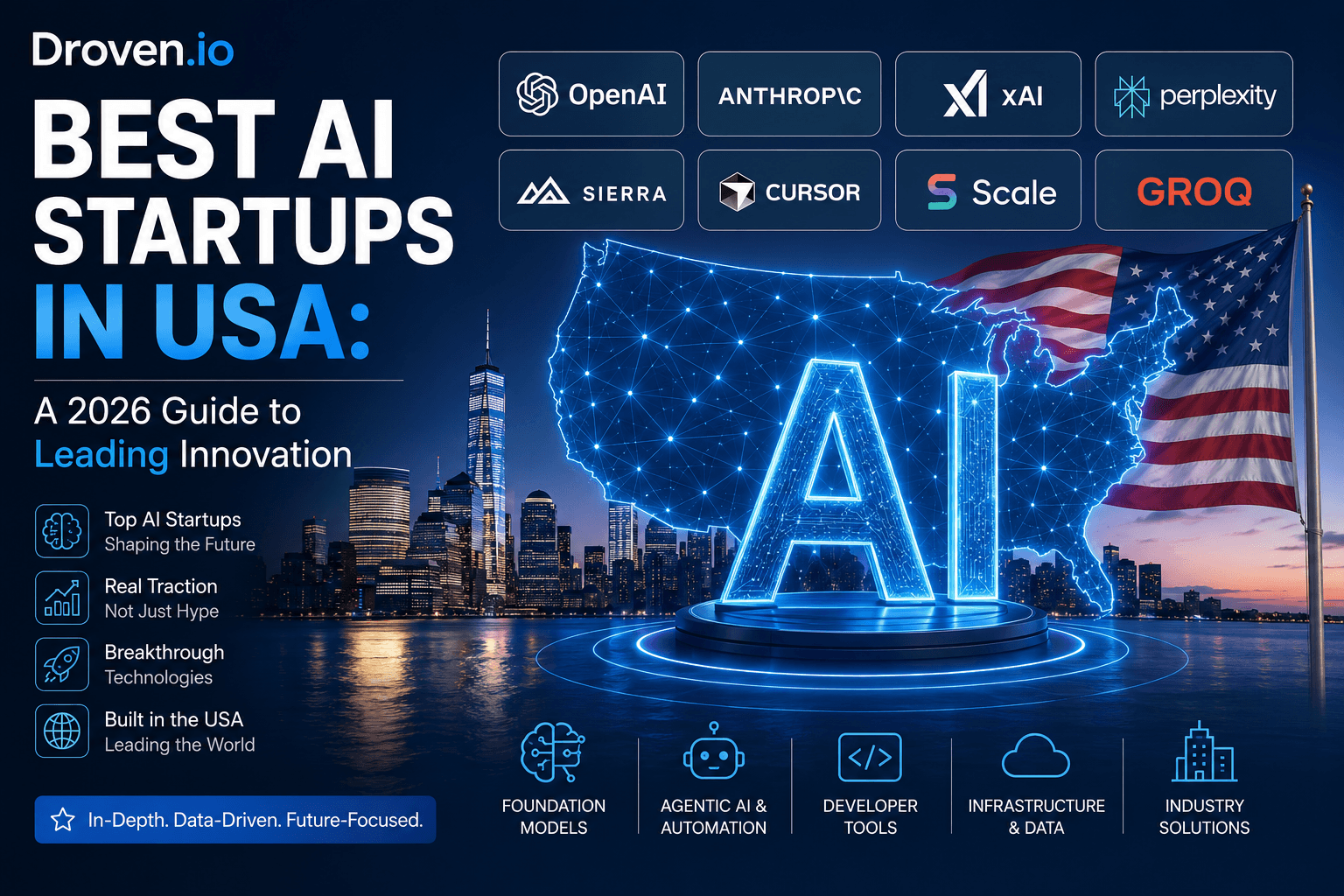
At the top of most rankings sit the foundation model companies, since their technology underpins much of what smaller startups build on top of. OpenAI remains one of the most influential names in this category, combining large-scale research with consumer tools, developer platforms, and enterprise products that together create an ecosystem far broader than a single chatbot.
Anthropic has carved out a distinct position by focusing on enterprise-grade AI systems built around safety and reliability, which has made it a preferred choice for organizations that prioritize careful deployment over speed alone. Its models are consistently recognized for strong reasoning performance, which matters a great deal for enterprise customers running high-stakes workflows rather than casual consumer chat.
Other frontier players like xAI and Perplexity round out this tier, each targeting slightly different audiences within the broader AI ecosystem. Groq has also become a notable name in this space, though its focus sits more on the hardware and inference speed side of the equation than on building consumer-facing models directly. Together, these companies illustrate how the foundation model tier has splintered into distinct strategic bets rather than a single race toward one dominant model.
Agentic AI and Customer Experience Startups
One of the clearer shifts documented across droven.io best ai startups in usa coverage is the move from simple chatbots toward autonomous agents capable of completing multi-step tasks with limited human oversight. Sierra is frequently mentioned in this context, focusing on AI agents that can handle real customer conversations rather than scripted responses.
This shift toward agentic systems reflects where the broader industry is heading, not simply which term happens to be trending in search results. Companies building genuine agentic capability are increasingly separated from those still marketing basic automation under a newer label.
Developer Tools Reshaping Software Work
Software development has become one of the clearest proving grounds for practical AI adoption. Anysphere, the company behind the coding tool Cursor, has seen rapid enterprise uptake by letting developers write, edit, and refine code with AI assistance built directly into their existing workflow.
This category matters because developer tools tend to succeed or fail based on daily, repeated usage rather than occasional interest. A tool that developers genuinely rely on every working day sends a much stronger signal than one that gets tried once and abandoned, which is exactly the kind of distinction droven.io best ai startups in usa analysis tries to highlight.
Infrastructure and Data Companies Behind the Scenes
Not every important AI company builds a consumer-facing product. Scale AI plays a critical role in the less visible infrastructure layer, focusing on data labeling and model evaluation, work that most end users never see but that underpins the reliability of the models built on top of it.
Similarly, companies providing compute infrastructure and cloud resources for training large models have become just as essential to the AI economy as the model builders themselves. Without this supporting layer, none of the more visible consumer and enterprise applications would function reliably at scale.
This part of the ecosystem rarely gets the same media attention as consumer-facing launches, largely because there is no flashy product demo to show off. Yet infrastructure providers often enjoy steadier, more predictable revenue than consumer apps, since enterprise contracts for compute and data services tend to be long-term commitments rather than one-time purchases. That stability is part of why infrastructure companies increasingly command serious attention from investors who have grown wary of consumer AI products that lose users as quickly as they gain them.
Vertical AI Solving Industry-Specific Problems
Beyond the general-purpose players, a growing number of startups focus narrowly on a single industry, applying AI to specific workflows in law, healthcare, finance, or hiring. Mercor, for example, has built infrastructure around workforce and hiring decisions, connecting organizations with skilled talent using AI-driven matching.
Vertical AI companies tend to be less flashy than foundation model builders, but they often solve more immediate, tangible problems for the businesses that adopt them. A law firm using an AI tool built specifically for legal research gets more targeted value than one trying to adapt a general-purpose model to the same task.
Healthcare has become another fertile area for this kind of specialized AI, with companies building tools that help clinicians handle documentation, reduce administrative burden, and surface relevant patient information faster. These applications rarely make headlines the way a new chatbot launch does, but the time savings they generate for overworked professionals translate directly into measurable business value, which is exactly the kind of outcome that separates a durable startup from a passing trend.
Why Funding Numbers Don’t Tell the Whole Story
It is tempting to judge a startup’s importance purely by how much money it has raised or what valuation it commands. But raw funding figures can be misleading, since a company can raise an enormous round on the strength of a strong narrative without necessarily having proven product usage to match it.
This is why serious analysis of droven.io best ai startups in usa candidates weighs funding alongside actual customer usage and revenue growth. A startup that demonstrates real, paying customer adoption alongside its funding round is in a fundamentally stronger position than one relying purely on speculative growth projections. Investors, job seekers, and business buyers alike benefit from looking past the headline number toward these underlying fundamentals.
Who Should Pay Attention to This List
Investors evaluating where to place capital clearly have a reason to track this kind of coverage, since it organizes a chaotic market into something closer to a structured overview. But the audience extends well beyond finance professionals.
Job seekers trying to choose between competing offers can use company profiles to understand which startups have durable business models versus which ones might struggle in a tougher funding environment. Developers deciding which tools to adopt in their daily workflow benefit from understanding which companies have proven enterprise traction rather than just early buzz. Business leaders evaluating vendors for automation projects get a similar advantage, using this kind of coverage to separate genuinely useful platforms from ones still searching for product-market fit.
Final Thoughts
The pace of AI innovation across the United States shows no sign of slowing down, and the number of startups competing for attention will likely keep growing through the rest of 2026 and beyond. Making sense of that landscape requires more than a list of famous names repeated from one article to the next.
Coverage built around droven.io best ai startups in usa criteria tries to offer something more useful: a structured way to separate genuine product traction from short-lived hype, organized by category and grounded in real usage rather than headlines alone. For anyone trying to understand where American AI innovation is actually heading, that structured approach is worth far more than another recycled top-ten list.
Read More Trending Blogs on Insider NYT.
