

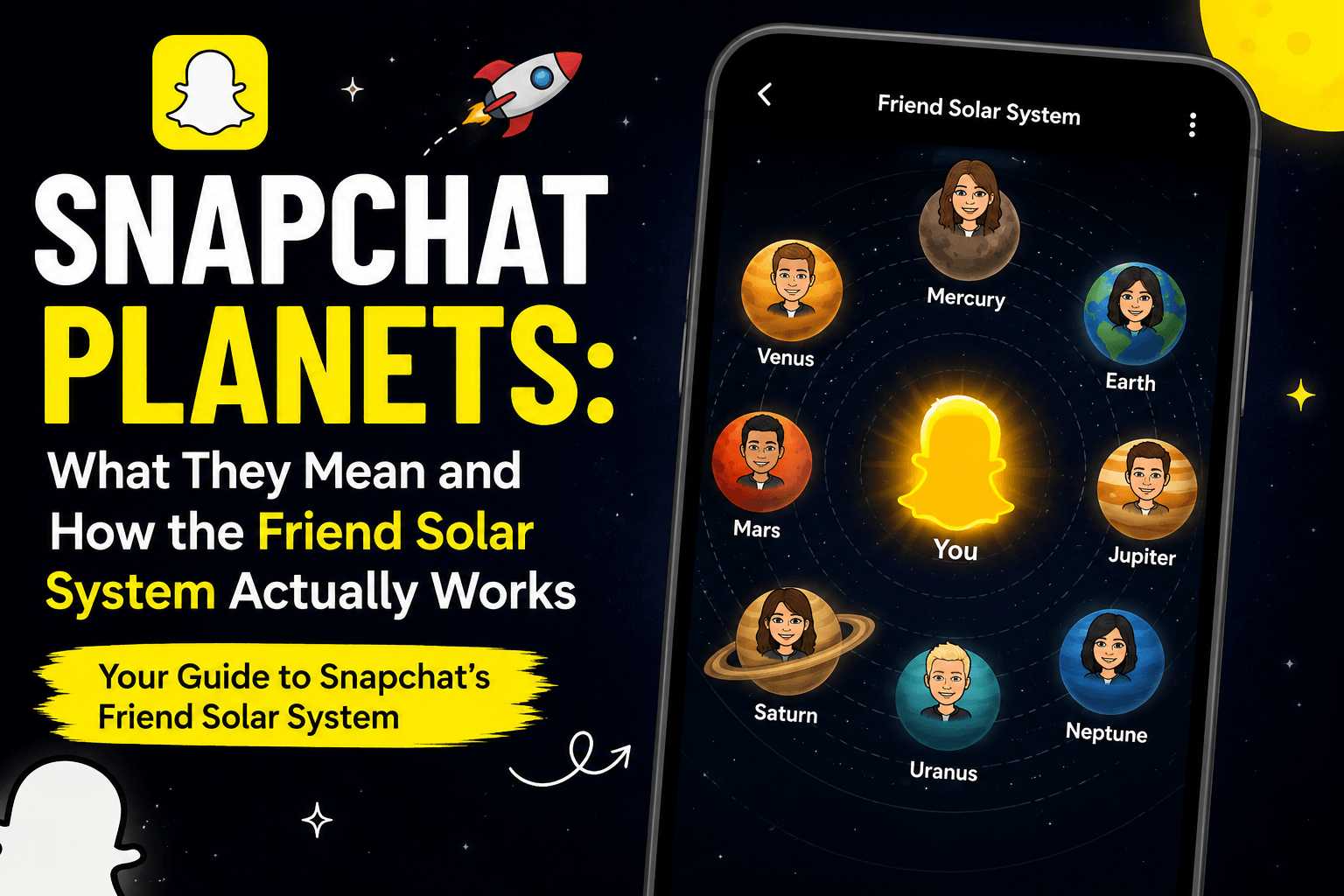
If you’ve ever tapped on a friend’s Snapchat profile and noticed a tiny glowing planet sitting next to their name, you’ve run into one of the app’s more talked-about features. Snapchat planets have become a genuine point of curiosity, and sometimes anxiety, for millions of users trying to figure out exactly where they stand in someone else’s social circle.
This guide breaks down what snapchat planets actually represent, how the ranking system works behind the scenes, and what to keep in mind if you’re checking your own placement or noticing changes over time.
What Snapchat Planets Actually Are
Officially, snapchat planets are part of a feature called the Friend Solar System, a visual tool exclusive to Snapchat Plus subscribers. The concept is fairly simple once you understand the layout. You’re positioned at the center like the sun, and your eight closest friends orbit around you as individual planets, ranked from Mercury all the way out to Neptune.
The closer a planet sits to the center, the more interaction that friendship reflects. Mercury, being the closest planet in real astronomy, represents your number one most-interacted friend on the app. Neptune, sitting at the outer edge, represents the eighth spot, meaning that person still made your top friend list but with noticeably less day-to-day interaction than the others.
This layout turns something that used to be a simple emoji-based ranking system into a more visual, almost gamified experience. Instead of just seeing a heart or a smiley face next to a name, snapchat planets give users a clearer sense of exactly where each friendship falls relative to the rest of their top connections.
When This Feature Was Introduced
Snapchat first rolled out this planetary ranking concept back in June 2022, initially launching across a set of roughly two dozen countries, including the United States, United Kingdom, Canada, Australia, India, and France. Since then, availability has expanded considerably, and by 2026 the feature is accessible across most major markets where Snapchat Plus is offered.
The timing of this rollout wasn’t random. Social apps had already been leaning into features that visualize closeness between users, and Snapchat’s approach with snapchat planets offered something more playful and visually distinct than a simple ranked list. It fit naturally into the app’s broader identity, which has always leaned on quirky, visually driven features rather than straightforward text-based interfaces.
How the Ranking System Actually Works
Behind the scenes, snapchat planets are determined by a combination of interaction signals rather than a single simple metric. Snapchat tracks things like how often you snap a particular friend, how frequently you chat with them, and how consistent your streaks or ongoing conversations have been over time.
Based on those combined signals, the app assigns each of your top eight friends a specific planet, with Mercury going to whoever you interact with the most and Neptune going to whoever ranks lowest among that top eight group. It’s worth noting that this ranking measures behavior and frequency, not necessarily emotional closeness or how much a friendship actually means to you personally.
That distinction matters more than people initially realize. A friend who ranks as your Neptune might genuinely mean more to you than someone sitting on Venus, simply because daily communication habits don’t always line up with how deep or meaningful a relationship actually is. The snapchat planets system is really just measuring frequency and consistency of digital interaction, nothing more.
Breaking Down Each Planet’s Position
Mercury holds the top spot among snapchat planets, representing the friend you interact with the most out of your entire top eight. This typically means the highest combined volume of snaps, chats, and consistent daily communication compared to anyone else in that group.
Venus sits just behind Mercury as the second closest position, reflecting a friendship that’s still extremely active but slightly less frequent than your number one connection. It’s common for Mercury and Venus to swap places fairly often, since these two top rankings tend to shift based on recent activity rather than staying fixed for long stretches.
Earth takes the third position, generally representing a friendship with steady, regular contact, without necessarily being the most active conversation in your daily routine. Mars follows as the fourth spot, often described as a reliable, ongoing connection that’s still meaningfully active, just with three other friends currently ranking slightly higher in terms of interaction frequency.
The remaining planets extend outward through Jupiter, Saturn, Uranus, and finally Neptune at the eighth and final position. Each step outward reflects a gradual decrease in day-to-day interaction, though every friend appearing anywhere within this group of eight planets is still considered part of your closest circle overall, just ranked based on recent communication patterns.
Why Rankings Shift Over Time
One of the more important things to understand about snapchat planets is that these rankings are not permanent. Since the entire system is built around ongoing interaction, a friend sitting comfortably on Venus today could easily slide down toward Neptune within a few weeks if conversations slow down or communication becomes less frequent.
This constant movement is part of what makes the feature feel alive rather than static. It reflects real changes in how often you’re actually talking to people, rather than locking in a ranking based on how a friendship used to look months or years earlier. For some users, this dynamic quality is part of the appeal, while for others it can feel a little unsettling to watch a close friend’s position shift downward simply because life got busier for a while.
It’s worth remembering that a temporary dip in someone’s snapchat planets ranking usually reflects nothing more than a quieter stretch of communication, not necessarily a change in how the friendship actually feels day to day.
How to Check Your Own Planet Ranking
Viewing your position within someone else’s snapchat planets setup requires an active Snapchat Plus subscription. Without that subscription, this particular feature simply isn’t accessible, regardless of how close your actual friendship might be.
To check your ranking, you’ll typically need to open your friend’s profile and look for a colored badge indicating their friend status with you. A badge reflecting Best Friends status generally means you’re somewhere within their top eight, while a more general Friends label suggests you’re part of their wider circle but not currently ranked among that smaller group. Tapping the appropriate badge reveals your specific planet placement within their personal solar system.
It’s important to note that this feature is turned off by default for new Snapchat Plus subscribers in many cases, meaning users sometimes need to manually enable visibility settings before their snapchat planets ranking becomes viewable to others at all.
Privacy and How Much Others Can See
A common misconception around snapchat planets involves how much visibility other people actually have into your rankings. In most cases, your own planet rankings remain private to you, meaning friends generally can’t see the full list of who ranks where in your personal solar system, only their own specific placement within it if you’ve enabled that visibility.
This privacy structure helps keep the feature feeling personal rather than turning into a public leaderboard. Rather than broadcasting an entire ranked list for anyone to browse, snapchat planets are designed around individual visibility, letting each friend see only their own position rather than comparing themselves directly against everyone else in your top eight.
Why This Feature Resonates With Users
Part of why snapchat planets generate so much conversation comes down to basic human curiosity about where we stand in other people’s lives. Ranking systems tied to social interaction tap into something universal, and turning that ranking into a visual solar system adds a layer of creativity that a simple numbered list wouldn’t achieve on its own.
This kind of feature also fits into a broader pattern across social platforms, where apps increasingly lean on visual, almost gamified elements to encourage continued engagement. Similar concepts exist elsewhere in slightly different forms, but Snapchat’s specific approach with planetary rankings has carved out its own distinct identity within that broader trend.
For many users, especially younger audiences who make up a large portion of Snapchat’s user base, checking snapchat planets rankings has become a casual, recurring habit, similar to checking a streak count or glancing at a friend’s Snap score.
A Few Things Worth Keeping in Mind
While snapchat planets can be fun to explore, it’s worth remembering that this system measures interaction frequency, not the actual depth or importance of a friendship. Treating a low ranking as some kind of definitive judgment on how much someone values you isn’t really an accurate way to interpret what the feature is measuring.
Communication patterns change constantly based on schedules, life circumstances, and simple daily habits, none of which necessarily reflect how meaningful a relationship actually is. Approaching snapchat planets as a lighthearted reflection of recent activity, rather than a definitive friendship ranking, tends to be the healthiest way to enjoy the feature without reading too much into normal, everyday fluctuations.
Final Thoughts
Snapchat planets offer a creative, visually engaging way to represent something that used to be shown through simple emojis and rankings. By turning your closest connections into an actual orbiting solar system, Snapchat has managed to make a familiar concept feel fresh and genuinely fun to explore.
Understanding how the ranking works, from Mercury’s top position down to Neptune’s outer spot, along with recognizing that these placements shift naturally over time, makes the entire feature easier to enjoy without unnecessary overthinking. Whether you’re checking your own ranking out of curiosity or just trying to understand what a friend’s badge means, knowing the mechanics behind snapchat planets takes a lot of the mystery out of one of Snapchat’s most talked-about features.
