

Anyone who has spent long hours sitting at a desk knows the toll it can take on the body. Stiff shoulders, a sore lower back, and that heavy feeling in the legs by mid-afternoon are common complaints among office workers and remote employees alike. This is exactly why so many people are searching for practical ways to change how they work, and one of the most common questions that comes up is what is a riser desk. Understanding the answer can make a real difference in daily comfort and long-term health.
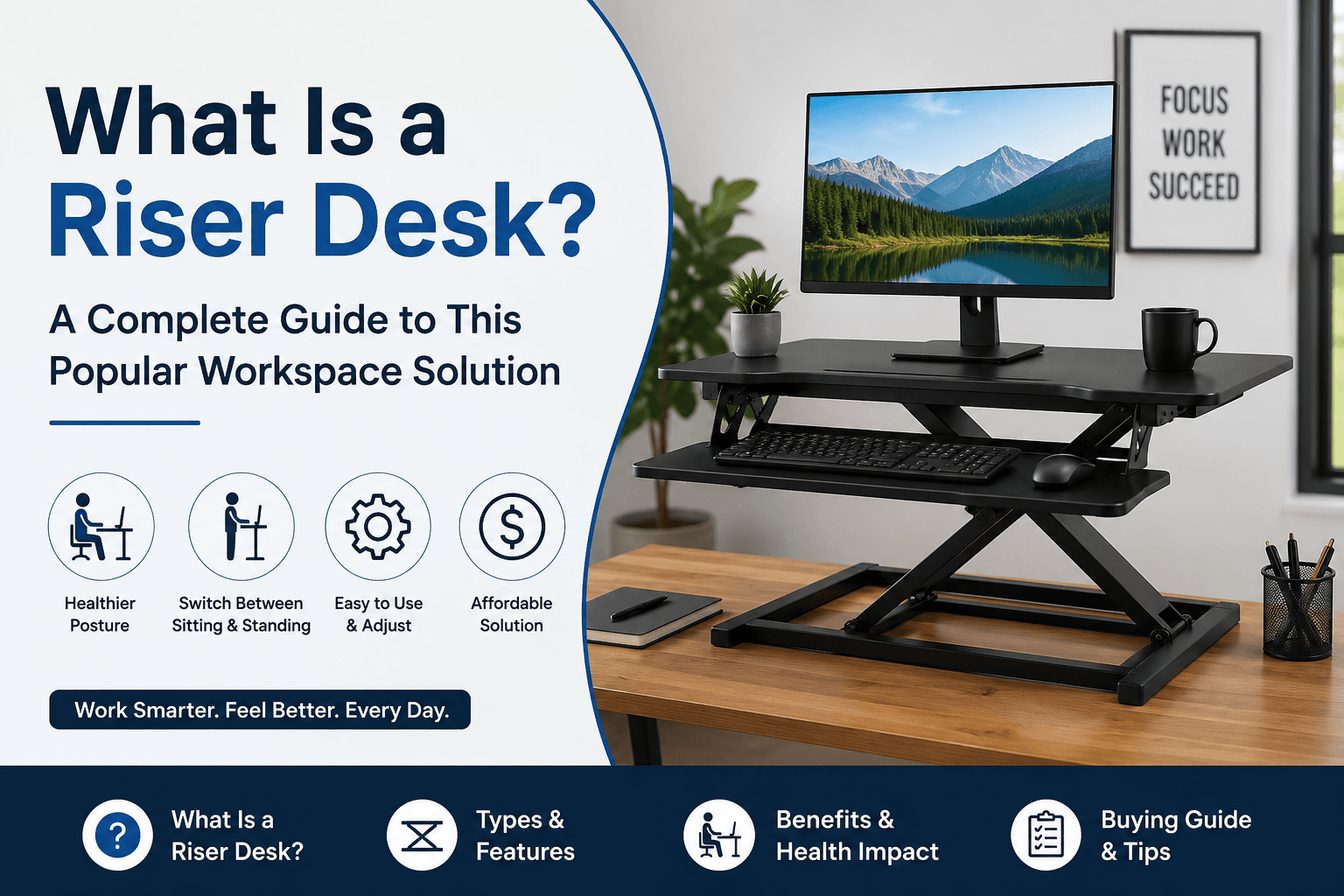
So what is a riser desk exactly? In simple terms, it is a device that sits on top of an existing desk and allows a person to raise their monitor, keyboard, and work surface to a standing height. Instead of replacing the entire desk, a riser desk works as an add-on that transforms a regular sitting desk into a flexible sit-stand workstation. This makes it one of the most affordable and accessible ways to introduce movement into a workday without buying brand new furniture.
Understanding the Basic Concept
To fully grasp what is a riser desk, it helps to picture a platform or a set of shelves that can be adjusted up and down. Most models use a spring-assisted or gas-lift mechanism, while others rely on a manual crank or an electric motor. Whichever mechanism is used, the goal is the same: to let the user switch between sitting and standing positions throughout the day without much effort.
The riser typically sits directly on the surface of a regular desk or table. Once placed, the user can adjust the height using a lever, a button, or a handle, depending on the model. When lowered, the setup looks and functions like a normal desk. When raised, the surface lifts high enough for the person to work comfortably while standing.
Why People Are Turning to Riser Desks
The rise in popularity of these products is closely tied to growing awareness of the health risks linked to prolonged sitting. Numerous workplace wellness programs now encourage employees to alternate between sitting and standing during the day. For someone new to this concept, learning what is a riser desk often becomes the first step toward making that change practical and affordable.
Unlike a full standing desk, which requires replacing the entire desk unit, a riser desk offers a middle ground. It gives the benefits of a sit-stand setup without the cost, the installation hassle, or the need to give up existing furniture that a person may already like or have invested in.
How a Riser Desk Differs From a Standing Desk
This is one of the most common points of confusion, and it is worth addressing clearly. A standing desk is a complete desk unit, usually with adjustable legs, that raises and lowers the entire tabletop. A riser desk, on the other hand, is a separate unit placed on top of any existing desk.
When people ask what is a riser desk in comparison to a standing desk, the simplest way to explain it is this: a standing desk changes the whole desk, while a riser desk changes only the top layer where the monitor and keyboard sit. Both accomplish a similar goal, but the riser is generally more budget-friendly and easier to set up since it does not require any structural changes to the existing furniture.
The Main Components of a Riser Desk
Anyone trying to picture what is a riser desk in practical terms should start by looking at its parts. Most riser desks share a few common parts. There is usually a base platform that touches the surface of the original desk. Above that sits the main work surface, which holds the monitor or laptop. Many models also include a separate lower platform designed specifically for a keyboard and mouse, keeping proper wrist alignment at both sitting and standing heights.
The lifting mechanism connects these platforms and allows them to move together. In simpler models, this might just be a single-tier surface without a distinct keyboard tray, while more advanced versions include dual platforms for a setup that closely resembles a full ergonomic desk.
Types of Riser Desks Available Today
Part of understanding what is a riser desk means recognizing that it is not a single, fixed product. There are several styles on the market, and knowing the differences helps when deciding which one suits a particular workspace. Fixed-height risers are the simplest, offering just one standing height with no adjustability, though these are less common today.
Spring-loaded riser desks use a counterbalance system that allows smooth height changes with minimal physical effort. These are popular because they respond quickly and do not require electricity.
Electric riser desks use a small motor to raise and lower the surface at the push of a button. These tend to be more expensive but offer the smoothest and most precise height adjustments, which can be especially useful for people who switch positions frequently throughout the day.
Manual crank models are another option, where the user turns a handle to adjust the height. These are usually more affordable than electric versions but require a bit more effort and time to adjust.
Materials and Build Quality
The materials used in a riser desk can vary quite a bit. Many budget-friendly options use engineered wood or laminate surfaces supported by a metal frame. These tend to be lightweight and suitable for smaller monitors or laptops.
Higher-end riser desks often use solid wood, tempered glass, or reinforced steel frames designed to support dual monitors or heavier equipment. When exploring what is a riser desk in terms of durability, it becomes clear that the build quality directly affects how much weight the unit can safely hold and how long it will last under daily use.
Who Benefits Most From Using One
Anyone weighing what is a riser desk against their own routine will find that certain groups benefit more than others. Riser desks are especially useful for people who work from home and do not want to invest in new furniture right away. They are also a practical choice for office environments where desks are shared or where a company wants to offer ergonomic flexibility without replacing every workstation.
Freelancers, students, and remote employees often turn to a riser desk as a cost-effective way to experiment with standing work before committing to a full standing desk. Because the setup can be added or removed easily, it also suits people who rent their living space and cannot make permanent changes to their furniture.
The Health Angle Behind Sit-Stand Setups
The health conversation around sitting too long has grown significantly in recent years. Extended periods of sitting have been linked to poor posture, reduced circulation, and general discomfort in the neck and back. Introducing regular movement, even something as simple as standing for part of the day, can help ease some of these issues.
This is part of the reason the question what is a riser desk comes up so often in wellness and productivity discussions. People are not just looking for a piece of office equipment; they are looking for a practical tool that supports better daily habits without requiring a complete lifestyle overhaul.
It is worth noting that a riser desk alone does not guarantee better health. It works best when paired with good posture habits, proper monitor height, and regular breaks to change position. Simply owning one is not a substitute for mindful movement throughout the day.
Setting Up a Riser Desk Correctly
Knowing what is a riser desk on paper is only half the picture; using one correctly matters just as much. Getting the most out of a riser desk depends heavily on proper setup. The monitor should sit at eye level so the neck does not strain forward or tilt downward. The keyboard and mouse should be positioned so the elbows form a comfortable angle, usually close to ninety degrees, whether sitting or standing.
Cable management also becomes more important with a riser desk, since cords need enough slack to allow for height adjustments without pulling or disconnecting. Many users invest in a cable management tray or clips to keep things tidy as the platform moves.
Anti-fatigue mats are another common addition. Standing on a hard floor for extended periods can cause discomfort in the feet and lower legs, so a supportive mat can make standing sessions more comfortable and sustainable over time.
Common Misconceptions
Some confusion about what is a riser desk comes from a few persistent myths. One frequent misunderstanding is that a riser desk is only useful for people who want to stand all day. In reality, most users alternate between sitting and standing rather than staying in one position for extended stretches. The goal is variation, not constant standing.
Another misconception involves cost. While some models can be pricier, especially electric versions with larger surfaces, many budget-friendly manual and spring-loaded options exist that make the switch to a sit-stand setup accessible for almost any budget.
Some people also assume a riser desk will fix existing back pain instantly. While it can help reduce strain from prolonged sitting, it is not a medical treatment, and persistent pain should always be discussed with a healthcare professional rather than left to furniture alone.
Choosing the Right Riser Desk
Once the basic question of what is a riser desk has been answered, the next step is picking the right one. When selecting a riser desk, it helps to think about the equipment that needs to sit on it. Someone using a single laptop has very different needs compared to someone running dual monitors alongside a keyboard and mouse. Checking the weight capacity of a unit before buying prevents issues with stability later on.
Desk depth also matters. A riser desk that is too deep for a small desk can hang over the edge, creating an unstable setup. Measuring the existing desk space before purchasing helps avoid this common mistake.
Adjustability range is another factor worth considering. Some users are quite tall or quite short, and not every riser desk accommodates the full range of comfortable standing heights. Checking the minimum and maximum height settings against personal measurements can prevent a poor fit after purchase.
The Growing Popularity of Riser Desks in Modern Workspaces
As more companies embrace hybrid and remote work arrangements, the demand for flexible, affordable ergonomic solutions continues to grow. A riser desk fits neatly into this shift because it does not require a complete office redesign. It can be placed on almost any desk, moved to a new location, or packed away when not needed.
This flexibility is a major reason why the question what is a riser desk keeps appearing in conversations about home office setups, productivity tools, and workplace wellness. It represents a practical, low-commitment way to improve daily comfort without a major financial or logistical investment.
Final Thoughts
To sum up what is a riser desk in one sentence: at its core, it is a simple but effective tool that sits on top of an existing desk to create a sit-stand workstation. It offers flexibility, affordability, and a straightforward way to reduce the strain that comes from sitting for long stretches of time. Whether someone works from a home office, a shared workspace, or a traditional corporate setting, understanding what is a riser desk opens the door to a more adaptable and comfortable way of working.
Choosing the right model comes down to personal needs, available desk space, and the type of equipment being used daily. With the right setup, a riser desk can become a small but meaningful upgrade to everyday comfort and long-term wellbeing at work.
Read More Trending Blogs on Insider NYT.
