

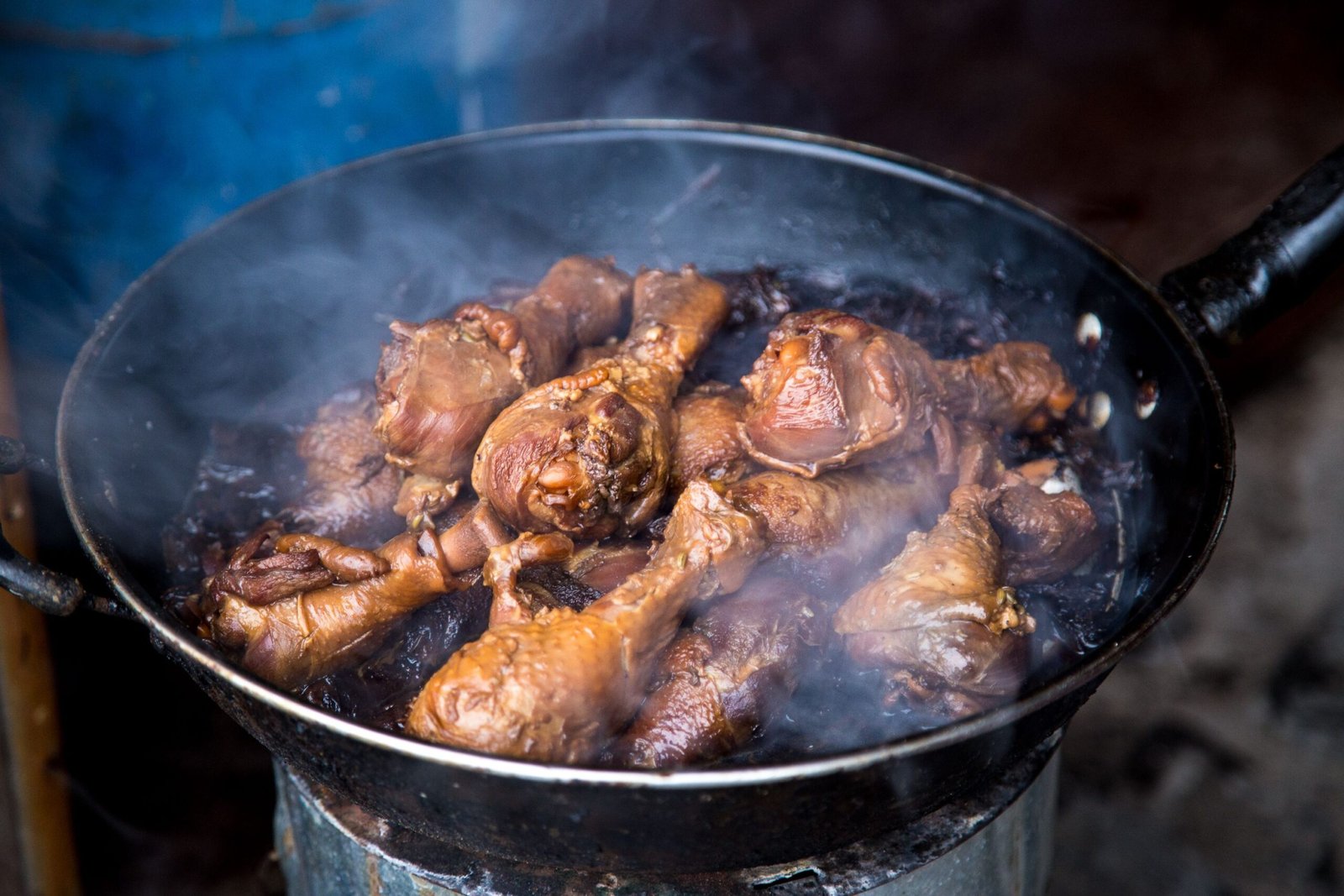
To cook chicken safely, bring every part of it to an internal temperature of 165°F (74°C) — that’s the one rule the whole process hangs on. You check it with a food thermometer in the thickest part of the meat, not by color, not by cutting it open, and not by guessing. Get that habit right, and baking, grilling, pan-searing, and air frying all become reliable ways to get dinner on the table.
The Temperature Rule You Should Never Bend
The USDA’s guidance on poultry is about as simple as food safety gets: cook all poultry to 165°F (74°C). Color lies — chicken can look perfectly done while the inside is still undercooked, and a pale pink tint near the bone can show up even in fully cooked meat. The only reading you can trust comes from a thermometer. Slide the probe into the thickest part, away from any bone, and wait for the number to settle. On a whole bird, check a couple of spots: the breast and the thickest part of the thigh.
A thermometer isn’t a gadget for perfectionists; it’s the cheapest insurance you can buy against both food poisoning and dry, overcooked chicken. Use it every single time.
Handling Raw Chicken Without the Worry
Raw chicken carries bacteria like salmonella, and safe handling is really just about keeping those bacteria away from everything else in your kitchen. Give chicken its own cutting board, keep ready-to-eat foods well clear of it, and wash your hands for a full 20 seconds after touching it. Anything that held raw chicken — plates, tongs, knives — needs a proper wash before it touches cooked food.
One habit worth dropping: rinsing chicken under the tap. It feels like cleaning, but all it does is fling bacteria onto your sink, faucet, and counters. Heat kills what’s on the meat; water just moves it around. For more kitchen guidance, browse our Food & Recipes section.
Leftovers deserve the same care. Get them into the fridge within 2 hours of cooking — sooner on a warm day — and eat them within 3 to 4 days.
Four Dependable Ways to Cook Chicken
Oven-Baking
The oven is the most forgiving method, which makes it the natural starting point. Heat it to 400–425°F, pat the chicken dry with paper towels, season it well, and roast until the thermometer reads 165°F. Boneless breasts need about 20–25 minutes at 425°F; bone-in thighs take 35–45 minutes at 400°F; drumsticks run 35–40 minutes. A whole bird needs 1¼ to 1½ hours at 375°F. Starting skin-side up and giving the pieces room on the pan does most of the work for you.
Grilling
Get the grill to medium-high — roughly 375 to 450°F — and keep the lid closed as much as you can, since every peek bleeds heat. Boneless breasts take 6–8 minutes per side, thighs 8–10, drumsticks 10–12. A two-zone setup is worth the extra minute: sear over direct heat, then finish over indirect heat so the outside doesn’t char before the inside is done. Find more ideas in our Food & Recipes section.
Pan-Searing
For weeknight speed, a hot skillet is hard to beat. Pound breasts to an even ¾-inch thickness so they cook through at the same rate, then sear over medium-high heat — about 6–7 minutes per side for breasts, 3–4 for tenders. Give each piece its space: a crowded pan steams instead of sears, and steamed chicken never browns.
Air Frying
An air fryer is essentially a small, fierce convection oven, and chicken loves it. Set it to 380°F — breasts take 15–18 minutes with a flip halfway through, tenders 8–10, thighs 20–25. That flip is what gets you even browning on both sides. Try more ideas in our Food & Recipes section next.

Chicken Cooking Times at a Glance
Treat these as starting points, not gospel. Ovens run hot or cold, pieces vary in size, and the meat’s starting temperature all shift the timing. The thermometer makes the final call, every time.
| Cut | Method | Temp | Approx. Time |
|---|---|---|---|
| Boneless breast | Bake | 425°F | 20–25 min |
| Boneless breast | Grill | Med-high | 6–8 min/side |
| Boneless breast | Pan-sear | Med-high | 6–7 min/side |
| Boneless breast | Air fry | 380°F | 15–18 min |
| Bone-in thighs | Bake | 400°F | 35–45 min |
| Whole chicken | Roast | 375°F | 1¼–1½ hrs |
How to Keep Chicken Juicy
Dry chicken is almost always overcooked chicken — and now you know how to prevent that. Beyond the thermometer, a few habits make juicy results the default rather than the exception.
Start with even thickness. Breasts are lopsided — thick at one end, thin at the other — so the thin end overcooks while the thick end catches up. A few firm whacks with a mallet or a heavy pan levels the playing field. Then pat the surface dry: moisture is the enemy of browning, and a blotted bird sears and crisps far better.
Salt deserves two things from you — generosity and time. Most bland chicken just needed more salt, and salt needs time to work its way in, so season well before cooking rather than at the last second. A quick brine is the same idea taken further: even a brief soak in salted water helps lean meat hold onto moisture. And always preheat properly — chicken hitting a lukewarm pan sticks, steams, and turns gray.
Then the hardest step: rest the meat 5–10 minutes before slicing. Cut too soon and the juices run onto the board instead of staying where they belong. Tent loosely with foil, wait, and you’ll taste the difference.

Mistakes Worth Avoiding
Guessing doneness. Cutting in to peek, judging by color, pressing it with a finger — none of these tell you what’s happening inside. If you don’t own a thermometer yet, consider this your sign.
Skipping the rest. Everything you worked for escapes onto the cutting board when you slice straight off the heat.
Overcrowding the pan. Too many pieces at once drops the temperature and traps steam, so nothing browns. Cook in batches if you must.
Using the wrong heat. Too hot and the outside chars before the inside cooks through; too cool and you get pale, rubbery meat. Match the heat to the method.
Cooking from frozen without adjusting. You can cook chicken straight from frozen — it just needs roughly 50% more time, and the very center still has to reach 165°F. What you must never do is thaw it on the counter, where bacteria multiply fast. Thaw in the fridge, in cold water changed every 30 minutes, or in the microwave if you’re cooking it right away.
Chicken has fed people across cultures for centuries — Wikipedia’s article on Chicken as food traces that long history. And for more kitchen guidance, browse our Food & Recipes section.
Common Questions
What temperature should chicken be cooked to?
165°F (74°C) in the thickest part — every cut, no exceptions. That’s the USDA’s rule.
How can I tell chicken is done without a thermometer?
Honestly, you can’t — not for certain. Color and texture look convincing, but neither reliably tells you the inside reached 165°F. If you cook chicken regularly, a thermometer is the most useful tool you can own.
How long do I bake chicken breast at 400°F?
Plan on about 22–28 minutes, and start checking at the 20-minute mark. Ovens vary, so treat time as a guide and temperature as the verdict.
Can I cook chicken from frozen?
Yes. It takes roughly 50% longer than thawed chicken, and the center still needs to hit 165°F. Just don’t thaw it on the counter first.
Should I wash chicken before cooking?
No. The USDA advises against it — rinsing spreads bacteria around the kitchen without making the chicken any safer.
Why is my chicken always dry?
Usually it’s overcooked past 165°F. Lean meat dries out fast once it overshoots, which is exactly why cooking by temperature changes everything.
Cook by Temperature, Not by Time
That’s really the whole philosophy. Times vary, ovens lie, and chicken pieces come in all sizes — but 165°F is 165°F every time. Get a thermometer, give the meat its rest, and chicken stops being a gamble and starts being dinner you can count on.
